
Garage Door Force Settings Too High or Too Low
Getting your garage door force settings right is critical for both performance and safety. If the force is set too high or too low, your garage door opener may struggle to operate correctly—or worse, create a hazard. Below is a practical listicle to help you diagnose and fix the issue with confidence.
1. What Garage Door Force Settings Actually Do
Garage door opener force settings play a critical role in balancing performance and safety during daily operation.
- Controls how much power is used when opening the garage door
- Regulates closing force to prevent excessive pressure
- Helps the door move smoothly without straining the motor
- Prevents damage to the garage door system over time
- Supports safety by stopping or reversing when resistance is detected
Taken together, these settings ensure the opener operates efficiently while minimizing risk. Properly adjusted force levels allow the system to respond appropriately to resistance, which protects both the mechanical components and anyone or anything in the door’s path.
2. Signs the Force Is Set Too High
When the force is excessive, your garage door may:
- Slam shut instead of closing smoothly
- Ignore resistance and continue closing
- Fail to reverse when something is in the way
This creates a serious safety risk, especially if safety sensors are bypassed or malfunctioning.
3. Signs the Force Is Set Too Low
Low force settings can cause:
- The door to stop before fully closing
- Reversal during travel without obstruction
- Difficulty opening fully
In this case, the garage door opener isn’t applying enough force to complete its cycle.
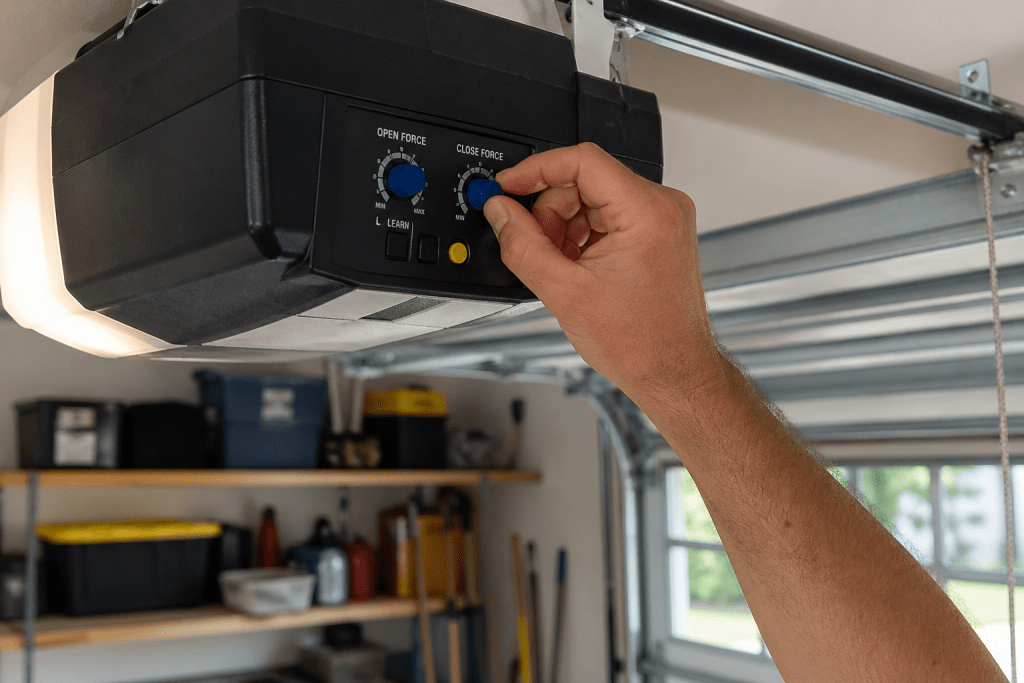
4. Locate the Adjustment Controls
Garage door openers typically include built-in controls that let you adjust how the system applies force during operation.
- Force adjustment controls are located directly on the garage door opener unit
- These controls often appear as dials or blue screws labeled “open force” and “close force”
- The exact position and setup should be confirmed using the manufacturer’s manual
Taken together, these elements show that force tuning is intentionally designed to be accessible but model-specific. While the controls are usually easy to identify on the unit itself, proper adjustment still depends on following the manual so the door operates safely and within the correct mechanical limits.
5. Make Slight Adjustments Only
Adjusting garage door force settings works best when done gradually, since small changes help you maintain control over the system’s behavior.
- Make small, incremental adjustments instead of large changes
- Increase or decrease force in gradual steps
- Test the garage door after each adjustment
- Observe how the door responds before making further changes
- Avoid overcorrection that can cause unsafe operation or strain
Viewed together, these practices emphasize control and precision over speed. Incremental adjustments reduce the likelihood of pushing the system beyond safe operating limits, allowing you to fine-tune performance while maintaining smooth and reliable garage door function.
6. How to Adjust the Force Properly
Garage door force adjustments rely on simple directional tuning to control how much power the opener applies during operation.
- Turn the adjustment screw clockwise to increase force
- Turn the adjustment screw counterclockwise to decrease force
- Make only slight adjustments at a time
- Test the garage door after each change
- Repeat until the optimal setting is achieved
Taken together, these steps highlight a controlled calibration process where direction determines force level and incremental testing ensures accuracy. This approach helps you dial in the correct balance between performance and safety without risking excessive force or inconsistent door behavior.
7. Don’t Confuse Force with Limit Settings
Garage door settings are divided into two separate controls that manage different aspects of how the system operates.
- Force controls how much power the opener uses during movement
- Limit settings control how far the garage door travels when opening or closing
- A door that doesn’t fully open may indicate a limit adjustment issue
- A door that doesn’t fully close may also point to incorrect travel limits
- Force adjustments are not always the solution for travel-related problems
Taken together, these distinctions show that force and limit settings serve different functions within the system. Force affects the strength of movement, while limits define the physical range of travel, meaning proper troubleshooting depends on identifying which control is actually causing the issue.
8. Test the Safety Features
Testing the garage door’s safety system after adjustments is essential to confirm that it will respond correctly to obstructions.
- Place a solid object in the door’s closing path
- Observe whether the door reverses upon contact or resistance
- Confirm that the safety reversal mechanism activates properly
- Check whether force settings may still be set too high
- Consider sensor issues if the door fails to respond correctly
Taken together, this process verifies that the garage door is operating within safe limits. If the door does not reverse when it encounters an obstruction, it signals a potential imbalance in force calibration or a problem with the safety sensors, both of which require immediate correction to maintain safe operation.
9. Inspect for Mechanical Issues
Garage door performance issues are not always caused by incorrect force settings, as other mechanical factors can interfere with smooth operation.
- Worn components can reduce efficiency and smooth movement
- Poor alignment of tracks or hardware can create resistance
- Lack of lubrication increases friction throughout the system
- These issues can mimic problems that seem force-related
- Unnecessary force adjustments may be made if root causes are missed
Taken together, these factors highlight the importance of diagnosing the system holistically. Mechanical wear, alignment issues, and friction often create resistance that leads users to incorrectly adjust force settings, when the real solution lies in restoring proper mechanical condition and movement efficiency.
10. When to Call for Garage Door Repair
When garage door adjustments do not fix the problem, the issue often requires a more thorough inspection than basic tuning can provide.
- Seek professional garage door repair if adjustments are ineffective
- Have a technician evaluate the opener for underlying faults
- Inspect sensors for alignment, damage, or signal failure
- Assess the overall system for hidden mechanical or electrical issues
- Ensure repairs are performed safely and correctly
Taken together, these steps reflect when troubleshooting should shift from DIY adjustment to expert diagnosis. Persistent issues often indicate deeper system faults, and professional evaluation helps ensure all components are checked comprehensively, restoring both safe operation and long-term reliability.
Final thoughts About Garage Door Force Adjustments
Dialing in the correct garage door force settings is essential for keeping your garage door system safe, responsive, and reliable. When the force is too high or too low, even small imbalances can lead to operational issues—like the garage door failing to close properly, reversing mid-travel, or placing unnecessary strain on the garage door opener. In many cases, a quick inspection of the opener controls and a few careful force adjustments can resolve the problem without extensive repair.
If your garage door is acting up, start by checking the opener unit, including the adjustment dials or blue screws, and observe how the door responds during opening and closing. Make slight adjustments as needed, and always test the system after each change. You should also confirm that the safety sensors are aligned and functioning correctly, since sensor issues can mimic incorrect force behavior.
Routine maintenance plays a major role in preventing recurring problems. Keeping all moving parts lubricated, checking alignment, and ensuring proper limit settings and travel limits will help your garage door operate smoothly every time. When adjustments aren’t enough, professional garage door repair can address deeper issues with the opener, parts, or overall system.Expert repair, installation, and replacement services from trusted providers like All Pro garage doors ensure your garage door system operates safely and efficiently. Whether it’s for a residential garage or a commercial property in Palm Harbor, Safety Harbor, Seminole, or anywhere in Florida.
FAQs About Garage Door Force and Adjustments
A properly calibrated garage door should open and close smoothly without hesitation. If the door stops mid-travel or reverses unexpectedly, the opener force may be too low. If it closes aggressively and ignores resistance, the force may be too high. Testing your garage door opener regularly ensures the system maintains safe operation and proper travel.
Yes, most garage door opener systems allow DIY force adjustments using built-in controls. Locate the adjustment dials or blue screws on the opener unit. Turn the adjustment screw clockwise in small increments if you need more power. Always make slight adjustments and test the garage door after each change to avoid overcorrecting the door force.
Force controls how much power the garage door opener uses, while limit settings determine how far the door travels. If your garage door doesn’t fully close or open, a limit adjustment or close limit setting may be required instead of increasing force. Misunderstanding these controls can lead to improper garage door repair attempts.
This usually indicates the force limit is too low or there’s an issue with the safety sensors. Check if the sensors are aligned and free from debris. If they’re working correctly, you can increase the open force slightly. Be cautious when adjusting, as too much force can compromise safety.
If your garage door continues to malfunction after adjusting controls, it’s time to call for garage door repair. Issues with worn parts, faulty sensors, or incorrect travel limits may require expert support. A professional can inspect all components, including the opener, controls, and mechanical parts, to ensure the garage door operates safely and efficiently.