
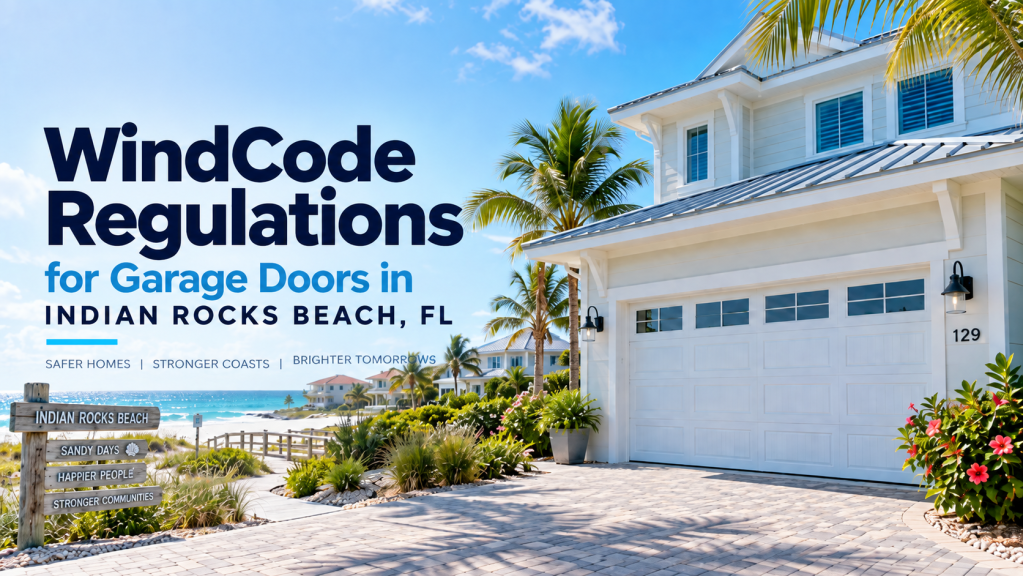
Garage doors in Indian Rocks Beach, Florida, must meet Florida Building Code wind-load requirements and applicable Pinellas County design criteria. Pinellas County’s published door-permit guidance uses a 145 MPH Risk Category II ultimate design wind speed (Vult), but that does not mean every home simply needs a “145 MPH garage door.” Exposure, mean roof height, garage door size, positive and negative design pressure, impact requirements, and the approved installation configuration all affect the actual requirement.
That distinction is especially important in Indian Rocks Beach because homes sit between the Gulf of Mexico and the Intracoastal Waterway. Properties with greater open-water exposure can experience different wind pressures than more sheltered homes. Understanding broader Florida garage door WindCode regulations helps explain why the correct garage door must be matched to the property rather than selected by MPH alone.
Florida Building Code Requirements for Indian Rocks Beach Garage Doors
Florida’s current Product Approval system uses the 2023 Florida Building Code, 8th Edition, effective December 31, 2023. Current approved garage-door documentation also references ASCE 7-22 when determining applicable wind loads and installation limitations.
Indian Rocks Beach is not within Florida’s formal High-Velocity Hurricane Zone, or HVHZ, which consists of Miami-Dade and Broward counties. It is still subject to significant coastal wind requirements and falls within the broader wind-borne debris framework where applicable. Nearby coastal examples include WindCode regulations in Clearwater Beach, garage door WindCode requirements in Sand Key, and WindCode regulations in Belleair Beach.
Is 145 MPH the Garage Door Requirement in Indian Rocks Beach?
145 MPH is an important design baseline, not a universal garage-door rating. Pinellas County’s published window and door form identifies 145 MPH for Risk Category II construction and provides different component-and-cladding pressures depending on exposure and opening height.
The final garage-door requirement can depend on:
- Wind exposure category
- Mean roof height
- Garage door width and height
- Effective wind area
- Building geometry
- Positive design pressure
- Negative design pressure
- Impact requirements
- Structural attachment conditions
Door dimensions are particularly important. A 9-foot single-car door and a 16-foot double-car door should not automatically be assumed to need the same reinforcement or PSF rating. Accurate garage door sizing and measurement is therefore part of selecting an approved system.
Exposure B, C, and D Affect Wind Pressure
Exposure describes how surrounding terrain affects approaching wind.
Exposure B generally applies to more protected developed areas, while Exposure C represents more open terrain. Exposure D represents the most exposed conditions associated with substantial unobstructed water or similar open surfaces.
Pinellas County’s published permit form provides a useful local comparison. At 145 MPH Risk Category II and an opening height of up to 15 feet, its reference pressures are +22.8/-30.0 PSF for Exposure B, +27.6/-36.3 PSF for Exposure C, and +33.5/-44.1 PSF for Exposure D. The county also defines exposure using distance from open-water shoreline for this permit form.
Those figures should not be treated as automatic garage-door ratings for every home, but they demonstrate why a Gulf-facing or otherwise exposed Indian Rocks Beach property may need a stronger configuration than a more sheltered home.
Mean Roof Height and Garage Door Size Matter
Wind speed alone does not determine pressure. Mean roof height and the size of the garage-door opening can change the forces acting on the assembly.
Pinellas County’s published tables increase component-and-cladding pressure as opening height increases. For Exposure D, for example, the reference negative pressure progresses from -44.1 PSF at 0–15 feet to -49.8 PSF at 25–30 feet.
The door itself also has to fall within the size limitations of its Florida Product Approval. Width, height, reinforcement arrangement, glazing, and design pressure can all change which configuration is approved. Homeowners comparing products can also review hurricane- and coastal-ready garage door options for Florida homes rather than relying on a generic wind-speed label.
Positive and Negative Design Pressure Are Critical
Garage-door wind resistance is evaluated using design pressure, usually expressed in pounds per square foot, or PSF.
Positive pressure pushes the garage door inward during high winds. Negative pressure creates suction that pulls the door outward. Both values matter because the door, tracks, reinforcement, and attachment system must resist forces in both directions.
Clopay’s Florida WindCode guidance states that a door’s design-pressure rating must equal or exceed the required pressure for the opening and that design pressure includes both positive and negative values. This is why comparing hurricane-rated garage doors requires more than checking the advertised MPH rating.
What Do WindCode W1 Through W9 Ratings Mean?
Clopay’s WindCode® system organizes wind-rated garage-door configurations using W-ratings. Wind speed, exposure, structural type, and required design pressure help determine the appropriate category.
However, WindCode is a manufacturer’s product-rating system, not the Florida Building Code itself. A W5, W6, W7, or other rating is useful only when the corresponding door configuration meets or exceeds the calculated positive and negative design pressures for the actual garage opening.
For Indian Rocks Beach homes, the correct W-rating should therefore be based on the project’s design conditions rather than a generalized chart for coastal Florida.
Indian Rocks Beach Is Within the Wind-Borne Debris Framework
The 2023 Florida Building Code defines a wind-borne debris region as areas where Vult is 140 MPH or greater, as well as certain areas within one mile of the mean high-water line where Exposure D exists and Vult reaches at least 130 MPH.
Because the Pinellas County reference criterion for Risk Category II is 145 MPH, wind-borne debris protection is a major consideration for exterior openings in Indian Rocks Beach. This is especially important when the garage door contains windows.
Impact-resistant glazing, approved protective systems, or another code-compliant configuration may be required depending on the product and project conditions.
Wind Resistance and Impact Resistance Are Different
A wind-rated garage door is not automatically impact resistant.
Wind resistance addresses pressure placed on the door. Impact resistance addresses flying debris striking the door or its glazed openings during a hurricane.
This distinction matters when comparing garage doors with decorative windows. A door may have adequate positive and negative PSF ratings while the glazing configuration is classified differently for impact performance.
The exact Florida Product Approval should therefore be checked for both the design pressure and impact classification rather than assuming a high WindCode rating automatically provides debris protection.
Florida Product Approval Must Match the Exact Door
The Florida Building Commission maintains a Product Approval system for products such as sectional exterior garage-door assemblies. The current database allows products to be searched by Florida approval number, manufacturer, code version, category, and other criteria.
A compliant garage-door configuration may specify:
- Manufacturer and model
- Florida Product Approval number
- Maximum width and height
- Positive and negative design pressure
- Impact or non-impact classification
- Glazing option
- Reinforcement arrangement
- Track configuration
- Anchor requirements
- Installation limitations
The approval number by itself is not enough. The actual installed configuration must match the approved drawings and limitations for the door being used.
Jamb Attachment and the Continuous Load Path Matter
A hurricane-rated garage door works as a complete system rather than as a reinforced panel by itself.
Wind loads move through the panels, horizontal reinforcement, hinges, tracks, brackets, anchors, jambs, headers, and structural framing. Together, these components create a continuous load path that transfers wind forces from the garage door into the structure.
Florida-approved garage-door documentation can specify anchor type, quantity, spacing, and mounting conditions. It may also change the required reinforcement according to door height and design load. Proper installation therefore means matching the entire approved configuration, not simply attaching a WindCode door to an existing opening.
Coastal Corrosion Can Weaken Garage Door Components
Indian Rocks Beach adds another challenge: constant exposure to humid, salt-rich coastal air.
Salt exposure can accelerate corrosion on tracks, springs, cables, hinges, brackets, reinforcement, rollers, and fasteners. Our guide to how sea air affects garage door components explains why this deterioration deserves closer attention near the Gulf.
Material selection can help. Garage door materials for coastal living and rust-resistant garage door hardware can reduce corrosion risk, although neither replaces the required wind, impact, and product-approval ratings.
Maintain Wind-Rated Garage Doors in Coastal Conditions
Even an approved WindCode garage door requires maintenance to keep its structural and operating components in good condition.
Salt deposits, corrosion, loose fasteners, worn rollers, damaged tracks, weakened springs, cable deterioration, and panel damage can affect everyday operation and may compromise parts of the system over time. Following appropriate coastal garage door maintenance practices and protecting garage door components from salt air are particularly relevant for barrier-island properties.
A structural WindCode rating should not be treated as a substitute for inspecting and maintaining the system.
Garage Door Permits in Indian Rocks Beach
Pinellas County Building and Development Review Services issues building permits and performs inspections for Indian Rocks Beach. Pinellas County advises residents in Indian Rocks Beach to check city requirements before submitting the county permit application.
The City of Indian Rocks Beach currently lists window and door replacement among projects for which local zoning approval and flood information may be required before submitting the building-permit application to Pinellas County. Permit requirements should therefore be confirmed for the individual project before work begins.
Wind Compliance and Flood Compliance Are Separate
WindCode compliance and flood compliance address different hazards.
Wind requirements deal with hurricane pressure, debris protection, and structural attachment. Flood requirements deal with factors such as flood zones, elevation, substantial improvements, and reconstruction requirements.
Indian Rocks Beach states that its location between the Gulf and Intracoastal Waterway makes it highly vulnerable to coastal flooding and identifies the city as being within Special Flood Hazard Areas. The city also notes that substantial improvements reaching applicable thresholds can trigger additional construction requirements.
For this reason, a garage door that satisfies its required PSF and impact rating does not automatically resolve every flood-related permitting issue for the property.
Inspect Garage Doors Before Hurricane Season
Wind-rated hardware should be inspected before severe weather arrives.
Tracks, reinforcement struts, brackets, fasteners, panels, springs, cables, and rollers should remain secure and free from serious deterioration. Garage door maintenance before hurricane season can help identify issues before storm conditions place additional stress on the assembly.
Panel condition also matters. Damaged garage door panels may require repair or replacement when dents, corrosion, separation, or structural damage affect the door. Older systems with repeated failures, obsolete reinforcement, or unverifiable wind ratings may also show signs that garage door replacement is needed.
Final Thoughts
WindCode regulations for garage doors in Indian Rocks Beach, FL, depend on more than a hurricane label or MPH rating. The correct system must account for the 145 MPH Risk Category II reference, exposure, mean roof height, door size, positive and negative design pressure, impact classification, Florida Product Approval, and proper structural attachment.
All Pro Garage Doors provides garage door installation, repair, and replacement throughout the Pinellas County area. For Indian Rocks Beach homes, proper installation, timely repairs, and replacement of outdated or damaged systems can help maintain code compliance, reliable operation, and storm readiness in demanding coastal conditions.